Black History Queen Graphics & T-Shirt Designs
First Impressions: Bold, Uplifting, and Ready for Real Crafting
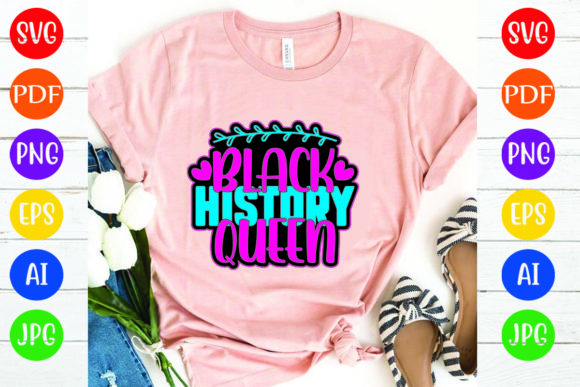
When I opened Black History Queen for the first time, I felt that familiar spark—the kind that tells me a design isn’t just pretty, but *purpose-built* for handmade work. It’s elegant without being stiff, bold without shouting, and deeply respectful while radiating quiet confidence. The illustration balances fine line work with strong silhouettes and intentional negative space—making it feel both contemporary and timeless. My Etsy shop leans into meaningful seasonal collections (Juneteenth, Black History Month, back-to-school empowerment themes), and this graphic instantly clicked as a centerpiece—not just for t-shirts, but for mugs, tote bags, gift tags, and printable wall art aimed at educators, moms, young creatives, and small business owners who value authenticity over trend-chasing.
Where This Graphic Design Asset Truly Shines
Black History Queen works exceptionally well across multiple real-world crafting workflows. For my Cricut project last week, I cut it cleanly on matte black vinyl for custom tumblers—no weeding headaches, no broken interior lines. On Silhouette Studio, the SVG imported flawlessly with grouped layers intact, letting me easily isolate the crown or adjust spacing before cutting stickers for planner pages. As a sublimation design, the high-res PNG held crisp detail even at 8” wide on ceramic mugs—and the transparent background meant zero white halos around edges. I also used the PDF layout to create a coordinated printable set: greeting cards, gift tags, and a mini wall-art sheet—all printed on premium cardstock with zero registration issues.
It’s especially effective in these contexts:
- Large-format cut files — perfect for tote bags, pillow covers, and oversized wall decals
- Clean printable layouts — ideal for printable bundles (e.g., “Empowerment Planner Kit” or “Classroom Celebration Pack”)
- Seasonal craft bundles — pairs beautifully with gold foil accents, kente-inspired borders, or minimalist typography
- Gift products — looks polished on enamel pins, sticker sheets, and thank-you cards for customer orders
- Small business branding — I added it subtly to my Etsy shop banner and packaging tape as part of a cohesive brand story
Where to Use It Thoughtfully
Like any quality graphic design asset, Black History Queen has sweet spots—and gentle boundaries. Because it includes delicate crown detailing and layered floral accents, I avoid scaling it below 1.5” for vinyl-cut stickers; tiny cuts risk fragility during weeding. Thin strokes don’t hold up well on low-resolution thermal printers, so I skip using the PNG for bulk-printed iron-on transfers unless I’ve upscaled and sharpened it first. Also, while the design reads beautifully on white and light heather tees, I always test it on dark garments using a white underbase—especially for sublimation mugs where contrast matters most. And if you’re layering multiple vinyl colors (e.g., gold crown + blush skin tone), simplify the file first—merge overlapping paths in Illustrator to prevent misalignment.
Practical Crafter Notes You’ll Actually Use
I treat every new SVG design like a raw material—not a finished product. Here’s how I vet Black History Queen before adding it to live listings:
- Test the SVG in Design Space: Confirm all compound paths are ungrouped and stroke widths are consistent—no hidden layers or double outlines.
- Preview the PNG transparency: Drop it onto black and white backgrounds in Canva to check for faint edge halos or compression artifacts.
- Verify resolution for sublimation: Open the PNG in Photoshop—300 DPI at intended print size is non-negotiable for mug or apparel mockups.
- Check color fidelity: Print a swatch on your target fabric or substrate—RGB screen colors lie. I always soft-proof using my printer profile.
- Mock it up, then re-mock it: Place it on real product mockups (not just templates)—I use Placeit for t-shirts and Kittl for mugs—to see how proportions land in context.
- Resize intelligently: When adapting for planner stickers or gift tags, I lock aspect ratio *and* increase stroke weight slightly to preserve legibility.
- Pair fonts with intention: I’ve found serif fonts (like Playfair Display) elevate its elegance for wall art, while rounded sans serifs (like Quicksand) soften it nicely for kids’ tote bags. Avoid overly decorative scripts—they compete with the illustration’s grace.
- Confirm commercial licensing: This is non-negotiable. Before listing anything on Etsy or fulfilling a custom order, I double-check the license permits print-on-demand, physical resale, and digital product bundling—no surprises later.
Why This Fits Seamlessly Into Handmade Business Workflows
As someone who juggles Cricut projects, printable design packs, and small-batch sublimation runs, I need graphics that wear many hats—and Black History Queen delivers. It’s not just another clipart download. It’s a versatile illustration that supports storytelling: for the teacher ordering 30 classroom mugs, the mom creating Juneteenth party favors, the Etsy seller launching a “Heritage & Hope” t-shirt collection, or the creative entrepreneur building a signature brand voice. Whether used solo or paired with coordinating patterns (I often bundle it with simple geometric frames or subtle watercolor textures), it adds emotional resonance without sacrificing technical reliability. In a crowded creative marketplace, that balance—of meaning, aesthetics, and craftsmanship—is rare. And that’s why Black History Queen earned a permanent spot in my active design assets folder—not just as a T-Shirt Designs staple, but as a trusted tool for authentic handmade business growth.